
When you've successfully navigated the four transition stages, you're ready to move on to the next step in reconfiguring your factory. You're ready to embark on your next peak. You may have a clear picture of what to do next with your life, but that picture might not seem so evident when that day comes and you start on your path.
You might feel paralyzed as you face the decision: what will you do with the years ahead?
As you consider "what now,” it is helpful to define the things that are most important to you as best you can—the things that give you the most happiness, joy, and satisfaction. The idea is to passively reflect and actively engage with your desires and aspirations, mapping them out as clearly as you map out business strategies.
On a business trip to New York, I found myself on a plane, daydreaming about what I'd do when I exited. Looking out the window across the empty sky, I imagined the day when I would finally have the resources to do whatever I wanted to make me happy. This got me thinking: will the money actually make me happier?

I decided to write down all the things that made me happy and rank them in a "Happiness Audit." I assigned a value (how happy it made me on a scale of 1-7), a cost to each item on my list, and the duration of how long each thing stayed with me. I fully expected to identify what on my list I could do more once I had more money at hand. Here's a sample of what I wrote down:
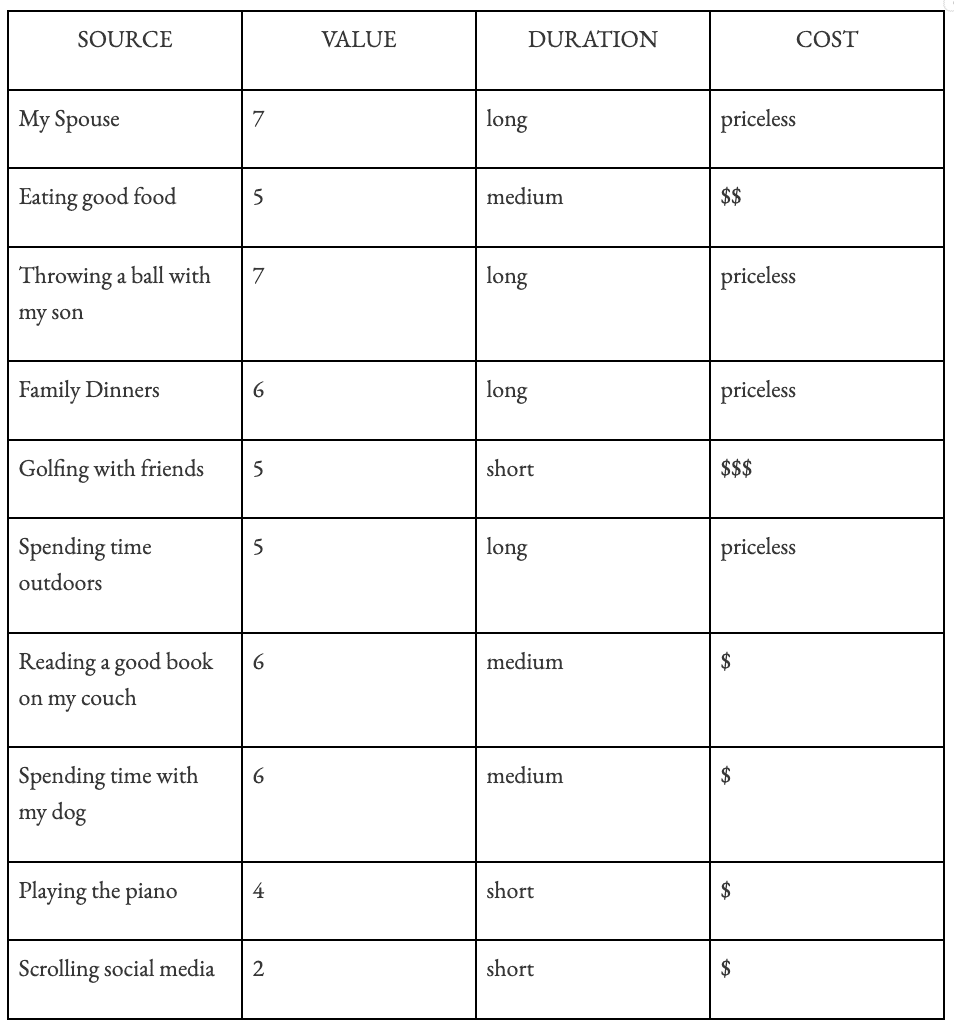
I was surprised to discover that most of what I wrote down, with the highest rankings on both value and duration, didn’t cost a lot. In fact, most of them cost literally nothing. What I had assumed would be a ticket to greater happiness had no bearing on how I wanted to spend my time to make me happy. The "Happiness Audit" tool provided a snapshot of my values and illuminated the discrepancies between what I thought would make me happy and what actually did. Quantifying happiness this way was enlightening—revealing that the simplest pleasures often yielded the highest returns regarding contentment and long-term satisfaction.
This realization echoed a powerful lesson a friend had taught me years earlier about the true source of happiness.
As I started building my business, I asked him, "But what if I'm unsuccessful?" This is a real fear for most of us, especially those setting out to build something of their own. His response was simple: "If you have all the money in the world, you vacation in Hawaii. If you can't afford Hawaii, you vacation in California. If you can't afford California, you'll go camping." His point is that there's a common denominator: spending time with loved ones, the part that makes you happy, was a constant. It doesn't matter where you are or how much you make. Ultimately, money doesn't play a significant role in determining your happiness.
The exercise I completed on the plane and my friend's advice changed my perspective on what makes me happy and helped me reorient my life toward what matters to me. When I exited, I revisited my spreadsheet, and I still find the Happiness Audit a valuable tool in finding a deeper purpose as I look to retool my factory. It is a helpful exercise to complete periodically at various stages of life—a simple check-in of who you are at your core and what makes you truly happy. In short, it can be the root of what gives you the strongest sense of purpose and the start of discovering what your next mountain will be.
Viktor Frankl, the esteemed Austrian psychologist, observed,
"Everyone has his own specific vocation or mission in life … Therein he cannot be replaced, nor can his life be repeated; thus, everyone's task is unique as his specific opportunity to implement it."
This perspective emphasizes that your mission should capture your unique contribution to the world, leveraging your strengths and passions.
As you review the results of your Happiness Audit, consider:
- What does your happiness audit tell you about what you should live for?
- What did you value most in your audit? What brings you the most joy?
- What is worth spending your resources on?
Find a quiet place and probe your heart and mind to find the answers to these questions.
This introspection is a powerful tool that clearly defines what you live for. It helps you focus on your pathway to the future, choose the goals that matter to you, and bypass the "fatal distractions" that can keep you from achieving your great purpose. Whether you use it as a periodic check in, or as the basis for your decision to decide your next peak, it’s always a good idea to look to the Happiness Audit.